Common Name
Ridgefin Snake Fin
Year Described
Ginsburg, 1951
Identification
Vertebrae: 168-171
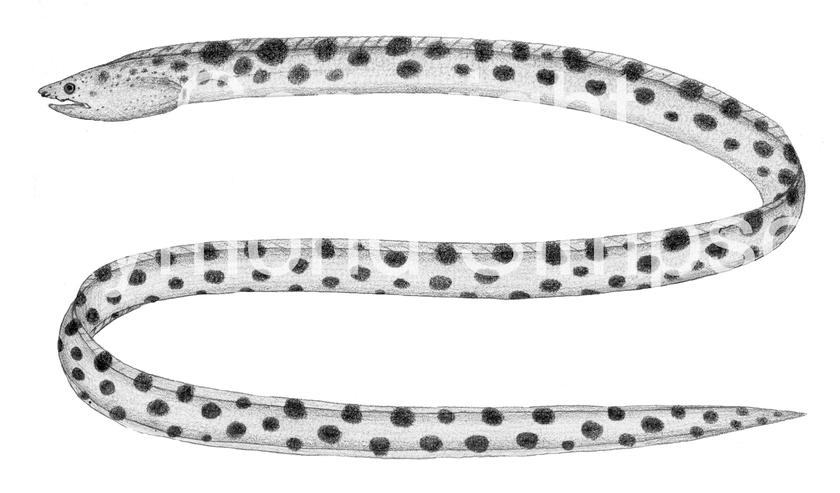
Body elongate and compressed. Trunk longer than tail (65-66% TL). Snout pointed and overhangs jaw. Anterior nostril tubular on underside of snout. Posterior nostril opens under eye on upper lip. Median groove on the underside of snout reaches to point forward of anterior nostril bases (common to all Callechelys). Teeth small and uniserial. Maxillary teeth 4-5. Dentary teeth 9-10. Vomerine teeth present. Intermaxillary teeth present. Head pores reduced to three supraorbital, two preopercular, and three supratemporal pores. Gill openings low on body and converging anteriorly. Dorsal fin origin well before gill openings, high in front, and ending before ail tip. Anal fin present. Pectoral and caudal fins absent. Tail tip hard and pointed. Lateral line complete.
Color
Body and head pale whitish to yellowish with spots on head and body. Spots on head much smaller than body. Large body spots and blotches can form saddles on the back. Eye pale.
Size
Maximum size to 80.1cm TL.
Habitat
Found on sandy bottoms from 22-36m.
Range
North Carolina to E. Florida.
References
McCosker, J.E. 1998. A revision of the snake-eel genus Callechelys (Anguilliformes: Ophichthidae) with the description of two new Indo-Pacific species and a new Callechelyin genus. Proc. Calif. Acad. Sci. 50(7):185-215.
Other Notes
Known only from a few specimens and very close to Callechelys guineensis. More material is needed to see if the vertebral counts and coloration differences are diagnostic of the two species being separate.